Parts Department Time Cards

Parts Department Time Cards

(Showing 5 of 5)

Before ordering, check what your clock is. Cards for a manual punch clock and sheets for a continuous feed computer system are not interchangeable, and that is the mistake most often made in this category. Parts department time cards come in both.

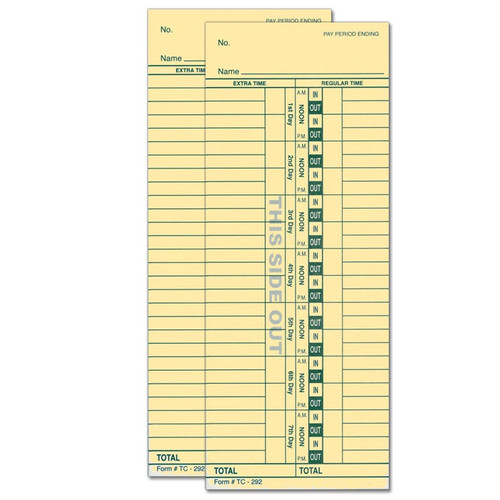
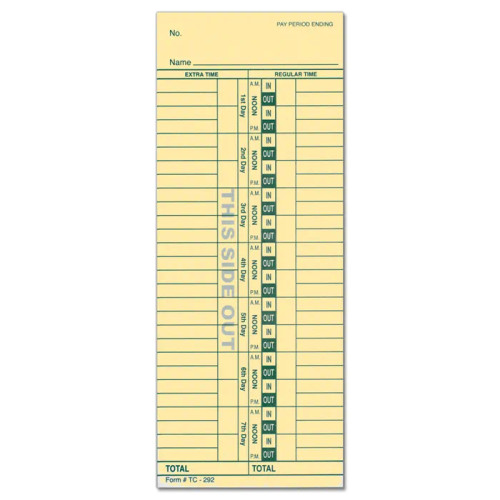
For manual clocks, three sizes share the same 3-1/2in width on heavy 125# manila; only the height changes, and height is recording space. TC-1 is the compact option at 8-1/2in, TC-292 the standard at 9in that fits most clocks, and TC-57 the tallest at 10-1/2in for departments recording more punches per period. Count the entries a full pay period generates before choosing, because a card that runs out mid period means a second card and a reconciliation.

If you run the TC-292 format, the two sided version prints both faces so one card covers two pay periods, halving the cards to distribute, collect and file across a year. The saving is handling time rather than card cost. For continuous feed systems, AA-292-VI sheets hold three cards across an 11-1/4in x 8-1/2in sheet on buff stock, and will not work in a manual punch clock any more than the individual cards will feed through a computer system.

Parts Department Time Cards

Before ordering, check what your clock is. Cards for a manual punch clock and cards for a continuous-feed computer system are not interchangeable, and that is the mistake most often made in this category.

Manual Punch Clock Cards

Three sizes, all 3-1/2in wide on 125# heavy duty manila stock printed in black. The difference is height, and height is recording space.

  • TC-1 at 3-1/2in x 8-1/2in, the compact option
  • TC-292 at 3-1/2in x 9in, the standard format that fits most manual clocks
  • TC-57 at 3-1/2in x 10-1/2in, the tallest, for departments recording more punches or more detail per card

Choose by how many entries a card has to hold across a pay period. A department where staff punch four times a day fills a card faster than one where they punch twice, and a card that runs out mid-period means a second card and a reconciliation.

Two Pay Periods Per Card

The TC-292-2 is the 2-sided version of the TC-292, printed on both sides of the same 125# manila stock at 3-1/2in x 9in, so one card covers two pay periods. That halves the number of cards handled and filed over a year, which matters more in payroll admin than the small price difference suggests.

Continuous-Feed Computer Systems

AA-292-VI time clock cards are for continuous-feed time clock computer systems, not manual punch clocks. Each 11-1/4in x 8-1/2in buff card stock sheet holds 3 time cards across, separated after printing. If your clock takes a fed sheet rather than an individual card punched by hand, this is the one you need, and the manual cards above will not work in it.

Choosing

  • Manual clock, light use: TC-1
  • Manual clock, standard: TC-292
  • Manual clock, heavy use or more detail: TC-57
  • Manual clock, fewer cards to handle: TC-292-2, two-sided
  • Continuous-feed computer system: AA-292-VI

Related Forms

For labor recorded against jobs rather than hours worked, see job time tickets and mechanic sheets. See also work and employee time cards in the HR range, special parts order forms, credit memo books, and all parts forms and books.

FAQ

Will these fit our time clock?

Check whether your clock is manual or continuous-feed first. TC-292, TC-1 and TC-57 are individual cards for manual punch clocks. AA-292-VI sheets are for continuous-feed computer systems. If you are unsure, measure the card slot on your clock and compare against the card dimensions.

Which height do I need?

All three manual cards are 3-1/2in wide; only the height changes. TC-1 at 8-1/2in, TC-292 at 9in, and TC-57 at 10-1/2in. More height means more punch lines per card, so count how many entries a full pay period generates before choosing.

Is the 2-sided card worth it?

Usually yes if you run the TC-292 format. The TC-292-2 covers two pay periods on one card, halving the number of cards to distribute, collect, and file. The saving is in handling time rather than card cost.

Why 125# manila stock?

Because a time card goes into a clock, gets pulled out, filed in a rack, and handled daily for two weeks. Lighter stock softens at the edges and starts to jam. The heavy manila holds its shape through a full pay period of handling, which is the whole job the card has to do.

What is the difference between a time card and a job time ticket?

A time card records hours an employee was present, for payroll. A job time ticket records labor against a specific repair order, for billing and productivity. Most departments need both, because paid hours and billed hours are different numbers and the gap between them is worth measuring.