
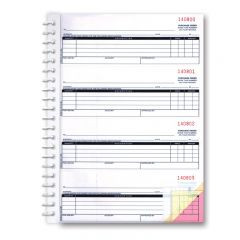
Purchase Order Books

Purchase Order Books

(Showing 6 of 6)

A purchase order book is what says an order was authorised before it was placed. Without one, a parts invoice arrives and nobody can say who approved it or at what price. Every book here is 8-1/2in x 11in, coil bound with a heavy cover that stops write through onto the pages beneath.

The first decision is copies. 2 part books give the vendor a copy and keep the control copy bound in the book, which is enough where accounting works from the book itself. 3 part books add a copy for accounting, for offices that work from documents delivered to them. The second decision is room: the standard 3 part fits four POs to a page at 200 per book, while the 3 Part/150 fits three larger POs for orders with more line items. If your POs regularly run out of space, take the larger format.

Every format is available imprinted with your logo and four lines of your own text, in 2 part, 3 part and 3 Part/150. The premium is modest and the case is practical rather than cosmetic: those four lines are where most dealerships print standing terms, such as requiring the PO number to appear on the invoice, and an instruction printed on every PO saves more admin than it costs. For fuel, keep a separate book so the spend reconciles in its own sequence.

Purchase Order Books

A PO is the document that says an order was authorised before it was placed. Without one, a parts invoice arrives and nobody can say who approved the purchase or at what price. All the books here are 8-1/2in x 11in, coil bound with a heavy stock cover that prevents write-through onto the pages beneath.

Two Part or Three Part

2-part books are carbonless in white and canary, with the control copy remaining bound in the book. One copy goes to the vendor, the record stays with you. This is enough where accounting works from the book itself.

3-part books add a pink copy, giving you vendor, accounting, and the bound control copy. Choose 3-part when the PO has to travel to accounting as a physical document rather than being pulled from the book at month end.

How Much Room Each PO Gets

Within the 3-part range the difference is POs per page. The standard 3-part book fits 4 POs per page at 2-3/4in x 7-1/2in each, 200 POs per book, which suits short orders at volume. The 3-Part/150 book fits 3 larger POs per page, for orders with more line items or longer descriptions. Fewer POs per book, more room on each.

Custom Imprinted

Every format is available imprinted with your logo and up to 4 lines of your own text: 2-part, 3-part, and 3-Part/150, form DSA-127-NC.

The custom premium is modest, and the argument is practical rather than cosmetic: a PO carrying your dealership name, address, and terms is easier for a vendor to process and harder to dispute later. The four custom lines are also where most dealerships put standing instructions, such as a requirement that the PO number appears on the invoice.

Choosing

Related Parts Forms

For fuel specifically, see fuel PO books, which keep fuel spend in its own sequence. See also special parts order forms, parts requisition and invoice forms, body shop forms, and all parts forms and books.

FAQ

2-part or 3-part?

Count who needs a physical copy. 2-part gives the vendor a copy and keeps the control copy in the book. 3-part adds a copy for accounting, which matters if your accounting office works from documents delivered to them rather than from the book itself.

What is the difference between the two 3-part books?

Space per PO. The standard book fits 4 POs per page and 200 per book. The 3-Part/150 fits 3 larger POs per page, so each one has more room for line items and description. If your POs regularly run out of space, take the larger format.

What does the control copy do?

It stays bound in the book and never leaves. Copies that go out can be lost, misfiled, or disputed; the bound copy gives you a complete sequential record of every PO written, in order, which is what makes a book auditable rather than just a pad of forms.

Is custom imprinting worth the extra?

For POs going to outside vendors, generally yes. Custom books carry your name, address and four lines of your own text, which is where most dealerships put standing terms such as requiring the PO number on the invoice. That instruction printed on every PO saves more admin time than the premium costs.

Why does the cover matter?

Carbonless paper transfers under pressure, so without a heavy cover between the page being written and the pages beneath, every PO leaves a faint impression on the following forms. A well-used book then becomes hard to read. The heavy stock cover is what prevents that.

Should fuel go in the same book?

Better not to. A dedicated fuel PO book keeps fuel spend in its own sequence so it reconciles as a single line, and lets you keep the book where vehicles are actually fuelled rather than at the parts counter. Mixed books have to be sorted before anything can be reconciled.