Purchase Order Books

Purchase Order Books

(Showing 11 of 11)

These are the purchase orders a dealership issues to its suppliers, committing to buy parts, services, shop supplies or subcontracted work. If you want the form a customer signs when buying a vehicle, that is a buyer's order and lives in car dealership sales forms.

A PO does two jobs: it authorises the spend before it happens, and it gives accounting something to match the invoice against when it arrives. Without one, the first anyone hears about a commitment is a bill. Bound books are coil bound with a heavy cover to stop write through, and the control copy stays in the book, which is what makes a missing PO visible. Two parts covers the vendor and your retained copy; three adds a departmental copy, which earns its place when the person ordering is not the person paying, as in a dealership they usually are not.

Beyond that it is space and format. Four POs per page suits routine supply orders, while fewer per page gives more room for subcontracted work or several itemised lines, and the extra space costs little against writing a second PO for the same order. If your system prints POs, blank laser stock replaces pre-printed books and costs less, with the CRPO forms doubling as cash receipts; holes or no holes is simply whether it gets filed or sent out. Imprinting matters more here than on most forms, since your PO sits in a vendor's accounts department beside a dozen others, and the one carrying your name and phone number gets matched without a call. Autosoft users should see Autosoft Purchase Orders.

Purchase Order Books

These are the purchase orders a dealership issues to its suppliers, committing to buy parts, services, shop supplies or subcontracted work. If you are looking for the form a customer signs when buying a vehicle, that is a buyer's order and lives in car dealership sales forms.

The PO does two jobs: it authorises the spend before it happens, and it gives accounting something to match the invoice against when it arrives. Without one, the first anyone knows about a commitment is a bill.

Bound Books

All coil bound with a heavy stock cover to prevent write-through, and the control copy stays in the book, which is what makes a missing PO visible.

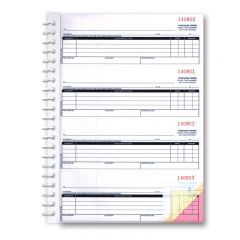
The 2-part book is white and canary at 8-1/2in x 11in with 4 POs per page. The 3-part book adds pink, also 4 POs per page at 2-3/4in x 7-1/2in each, 200 POs per book. The 3-Part/150 runs fewer POs per page, giving more writing space on each.

Custom imprinted versions are available in 2-part, 3-part and DSA-127-NC 3-part.

Two Parts or Three

Two parts covers the vendor and your retained control copy. Three adds a copy for the department that raised the order.

The third copy earns its place when purchasing and accounting are different people, which in a dealership they usually are. The parts manager who ordered the item keeps proof of what was authorised, accounting matches the invoice to the file copy, and the book itself holds the sequence.

How Many POs Per Page

Four per page suits routine orders: a case of oil, a box of gloves, a courier run. Three per page gives more room per order, which matters when you are describing subcontracted work or itemising several lines.

If your POs regularly run out of space, the extra room costs very little against the time spent writing a second PO for the same order.

Laser Forms

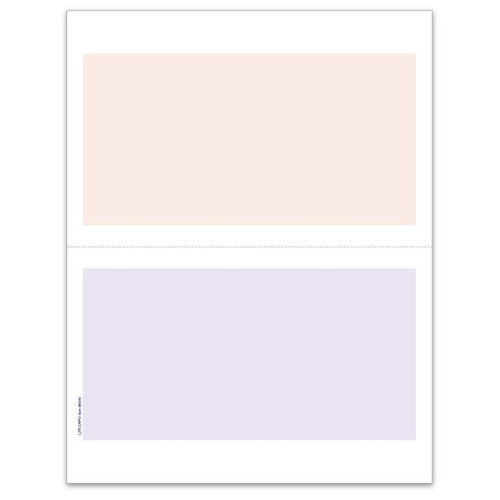
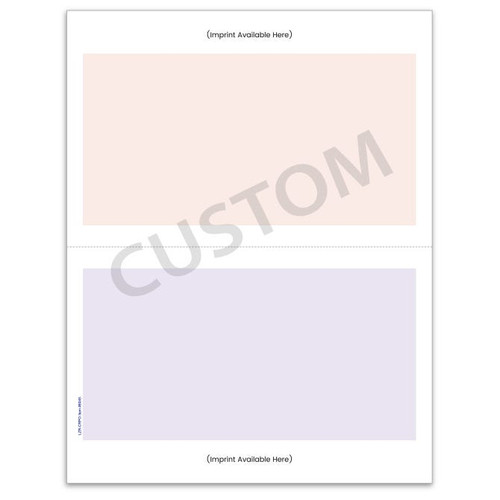
If your system prints POs, blank laser stock replaces pre-printed books and costs less. The LZR-CRPO without holes and LZR-CRPOFH with holes serve as cash receipts or purchase orders, so one stock covers both. Imprinted versions are available without holes and with.

For ERA systems specifically, the imprinted LZR-PO is a dedicated purchase order form.

Holes or no holes is a filing decision: pre-punched stock goes straight into a binder, unpunched suits POs that get sent out rather than filed.

Autosoft Users

Autosoft Purchase Orders are pre-printed laser forms for Autosoft FLEX DMS. Production is 2 to 3 business days standard, 1 to 2 on rush. Call us for current pricing and lead time before ordering.

Imprinting Is Worth More on POs Than Most Forms

A purchase order leaves your building and sits in a vendor's accounts department, often alongside POs from a dozen other businesses. An imprinted PO carrying your name, address and phone gets matched and processed; a generic one with a handwritten header is the one that gets queried.

Note that imprinted laser forms are priced per sheet while books are priced per book, so compare on total quantity rather than on the figures side by side.

Related Forms

For parts department ordering specifically, see parts purchase order books, special parts order forms and fuel PO books.

In accounting, see cash receipts books, journal voucher forms, laser AR statements and all car dealership accounting forms. Browse office supplies.

FAQ

Is this the form a customer signs to buy a car?

No. These are purchase orders your dealership issues to suppliers. The document a customer signs when buying a vehicle is a buyer's order, which you will find under car dealership sales forms.

2-part or 3-part?

Whether the department needs its own copy. Two parts gives the vendor a copy with the control copy bound in the book. Three parts adds a departmental copy, which matters when the person ordering is not the person paying the invoice.

How much space do we need per PO?

Count the lines a typical order uses. Four per page suits routine supply orders. If you are describing subcontracted work or itemising several parts, the 3-Part/150 gives more room per order and avoids running a single order across two POs.

Book or laser form?

Whether your system generates POs. If it does, laser stock costs less and prints on demand. If POs are written by hand at a counter or in a shop, a bound book keeps the sequence and the control copy together, which loose sheets do not.

Why does the control copy staying in the book matter?

Because it makes an unauthorised or missing commitment visible. A bound sequence with a gap prompts a question. A loose file of POs does not, since nobody notices what is absent. It is the same principle as pre-numbered receipts.

Should we imprint our POs?

Usually yes. Your PO sits in a vendor's accounts department next to many others, and one carrying your name, address and phone number gets matched to the right account without a call. Imprinted books cost modestly more and remove a recurring source of admin friction.